Institutional FX Insights: UBS BoJ Regime Shift

UBS FX & JAPAN EQUITIES STRATEGY BRIEFING: BOJ REGIME SHIFT
THE TAKE: BREAKDOWN OF THE OLD PLAYBOOK AS THE BOJ NORMALISATION ACCELERATES
The Bank of Japan's rate decision marks a structural regime shift: the traditional correlation playbook—BOJ dovish inaction $\rightarrow$ JPY weakens $\rightarrow$ Nikkei surges—is officially breaking down. While the policy rate was left unchanged at 1.25%, the policy statement and macroeconomic projections delivered a distinctly hawkish normalization signal.
Underlying inflation is now evaluated as broadly consistent with the 2% price target, the FY2027 inflation forecast was upgraded to 2.6% (from 2.4%), and upside inflation risks remain prominent. Crucially, the BOJ accelerated balance sheet normalization by expanding annual equity ETF disposals from ~JPY 330 billion to JPY 860 billion per year starting in January, compressing the implied runoff timeline from 112 years to 43 years. This removes long-standing structural market support, increases December hike probabilities, and turns the yen into a macro tailwind while establishing clear valuation headwinds for Japanese equities.
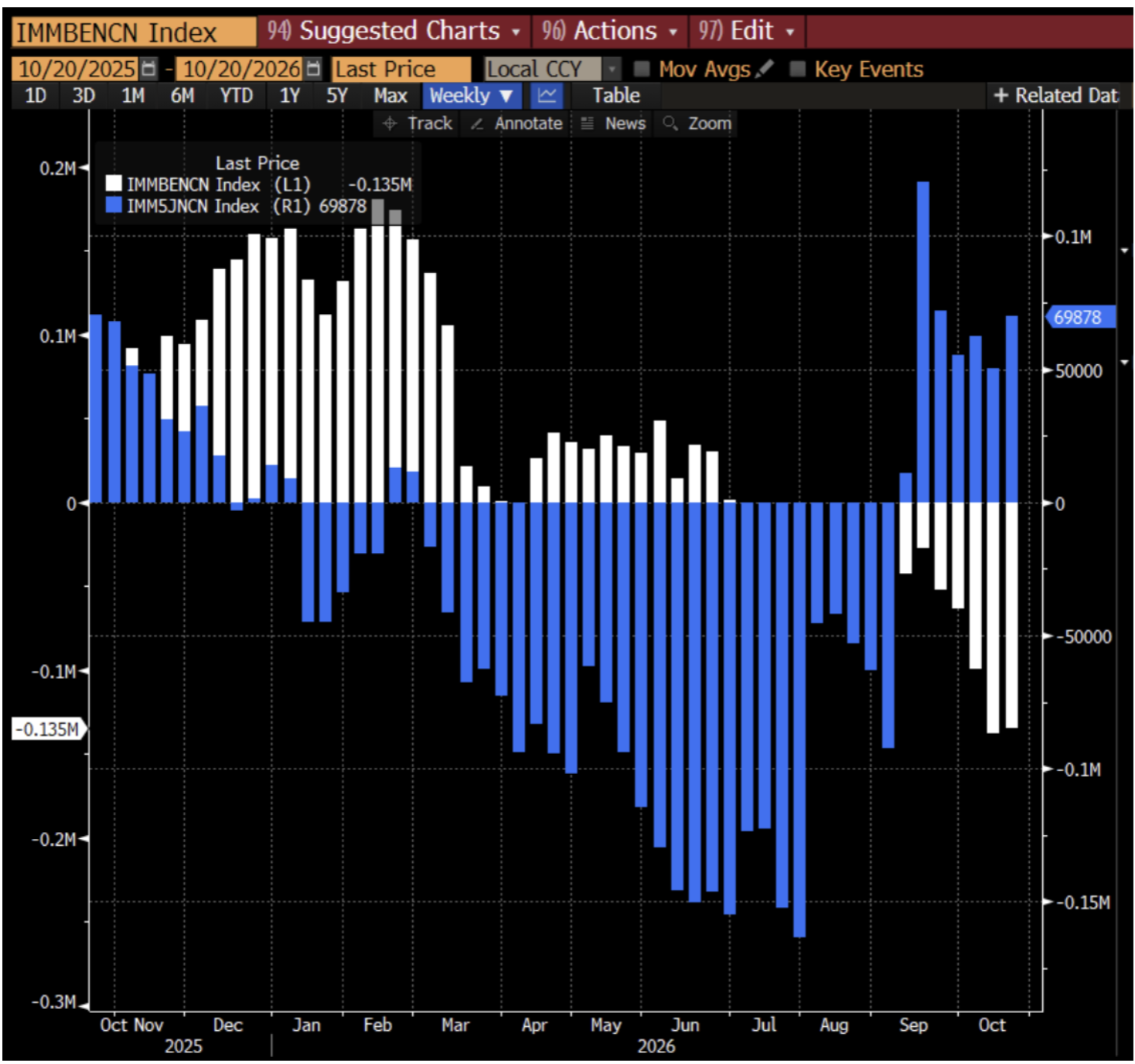
CFTC SPECULATIVE POSITIONING DIVERGENCE: JPY VS. EUR
Speculative capital has decisively abandoned the Japanese Yen as the global consensus funding short, transferring funding pressure onto the Euro amid French political instability and sovereign spread widening (Franco-German 10Y holding at 137 bps).
Currency Asset | Speculative Net Positioning (CFTC as of Oct 20) | Multi-Week Flow Trend | Narrative & Transmission Vector |
Japanese Yen ( | Net Long +69k contracts | 7 consecutive weeks of net buying | BOJ rate hike pricing, ETF balance-sheet runoff, safe-haven bids, exporter hedging. |
Euro ( | Net Short -135k contracts | 16 consecutive weeks of net selling | French fiscal deficits, budget protests, Moody’s Aa3 negative outlook, neutral ECB. |
MACRO & FLOW TRANSMISSION CHANNELS
Carry Trade Unwinds: Expanding BOJ hike expectations compress rate differentials against G10 peers, actively disincentivizing yen-funded carry trades.
Corporate Flow Imbalance: Domestic importers remain on the sidelines post-central bank decisions, muting USD dip-buying. Concurrently, Japanese exporters are aggressively locking in hedge ratios at elevated 157.00–158.00 levels, establishing a firm supply ceiling.
Equity Multiple Compression: Accelerating ETF sales remove programmatic liquidity, while higher domestic Japanese Government Bond (JGB) yields and a firmer yen compress forward P/E multiples across high-beta exporter segments.
TACTICAL CROSS-ASSET TRADE PLAYBOOK
1. Sell USDJPY Rallies (Fading Carry)
Execution Zone: 157.50 – 158.00
Downside Targets: 155.00 (Initial), 153.50 (Extended)
Risk Invalidation: 159.20 Stop
2. Relative Value: Sell EURJPY Rallies (Preferred Expression)
Execution Zone: 181.50 – 182.50
Downside Targets: 178.50 (Initial), 176.00 (Extended)
Risk Invalidation: 184.00 Stop
Rationale: Isolates the divergence between BOJ hawkish policy normalization and escalating French political/fiscal tail risk.
3. Tactical Nikkei 225 Range Framework & Hedging
Regime Stance: Two-way volatility regime; avoid chasing upside into JPY strength.
Support / Buy Zone: 62,000 – 63,000 (Accumulate domestic-demand/value names; strictly avoid high-beta exporters).
Neutral Consolidation Corridor: 65,000 – 69,000
Upside Recovery Cap: 72,000 – 74,000
Invalidation / Capitulation Level: Sustained breakdown below 62,000 triggers systematic trend unwinds.
Portfolio Overlay: Pair long Japanese cash equity exposures with long JPY vs. USD or EUR option/forward structures to neutralize exporter FX drawdowns.
Disclaimer: The material provided is for information purposes only and should not be considered as investment advice. The views, information, or opinions expressed in the text belong solely to the author, and not to the author’s employer, organization, committee or other group or individual or company.
Past performance is not indicative of future results.
High Risk Warning: CFDs are complex instruments and come with a high risk of losing money rapidly due to leverage. 68% and 74% of retail investor accounts lose money when trading CFDs with Tickmill UK Ltd and Tickmill Europe Ltd respectively. You should consider whether you understand how CFDs work and whether you can afford to take the high risk of losing your money.
Futures and Options: Trading futures and options on margin carries a high degree of risk and may result in losses exceeding your initial investment. These products are not suitable for all investors. Ensure you fully understand the risks and take appropriate care to manage your risk.
Patrick has been involved in the financial markets for well over a decade as a self-educated professional trader and money manager. Flitting between the roles of market commentator, analyst and mentor, Patrick has improved the technical skills and psychological stance of literally hundreds of traders – coaching them to become savvy market operators!